The Engineering and Design of Safety Pins
At first glance, the safety pin appears to be a trivial household object. However, from a mechanical engineering perspective, it is a highly optimized, single-piece compliance mechanism. It functions simultaneously as a structural beam, a torsion spring, and a self-locking friction fastener.
Invented in 1849 by Walter Hunt, the foundational design remains unchanged because it elegantly solves multiple mechanical problems using a single piece of wire. This guide explores the deep technical principles, material science, and stress analysis that govern the engineering of safety pins.
"At Suvik Overseas, our engineering department views the safety pin as a precision instrument. Operating under strict ISO 9001:2015 quality systems since 1970, we utilize automated inspection and advanced metallurgy to ensure that every pin we produce exhibits the perfect balance of yield strength, elastic recovery, and corrosion resistance."
Design Objectives and Anatomy
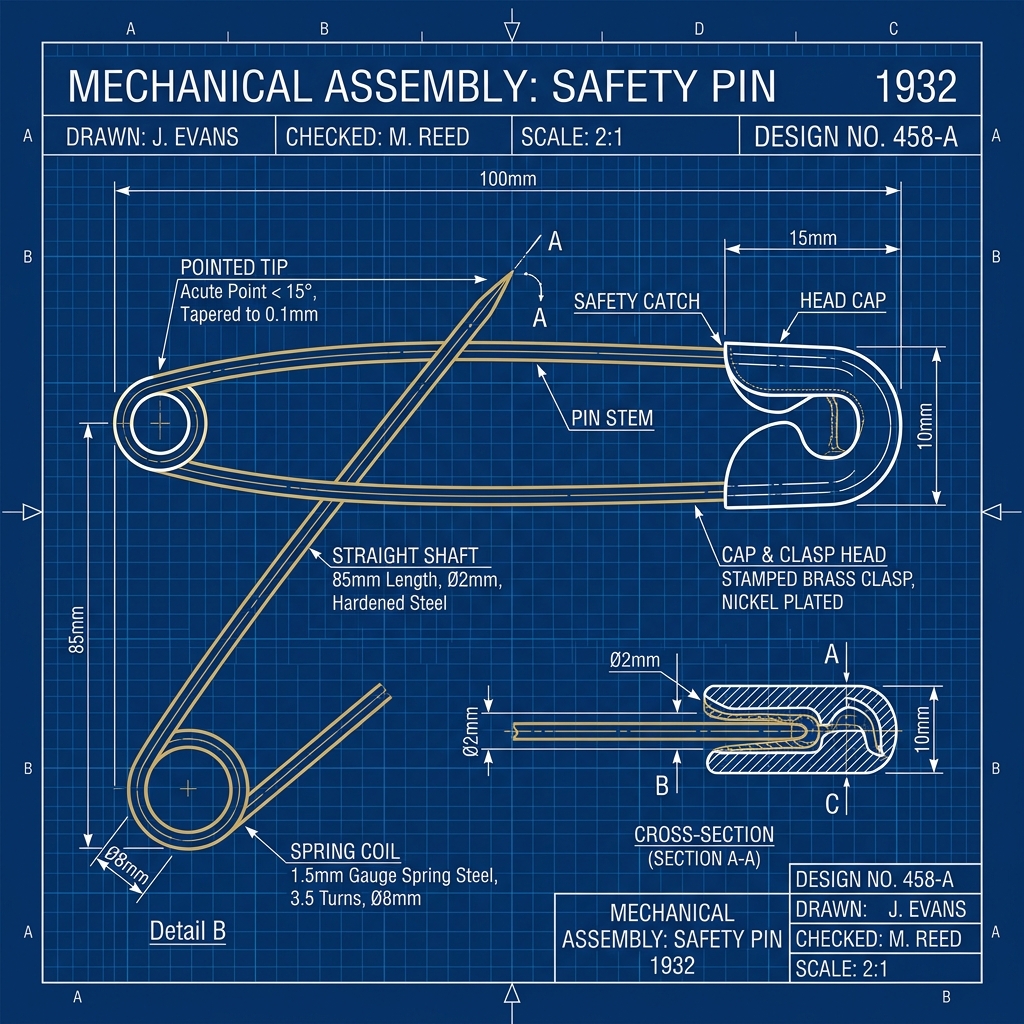
The core design objectives of a safety pin are safety (shielding the sharp point), durability (high fatigue cycle limit), ease of use (ergonomic actuation force), and manufacturing efficiency (ability to be formed from a continuous wire spool). To achieve this, the pin is divided into five distinct mechanical zones:
- The Point: Precision-ground to an optimal angle to reduce penetration friction while maintaining structural integrity against tip fracture.
- The Actuation Arm (Shaft): Acts as a cantilever beam subjected to bending moments during insertion and closure.
- The Torsion Coil (Spring): The energy-storage mechanism that provides the restoring force required for the pin to spring open.
- The Fixed Arm: The structural backbone that anchors the clasp and opposes the forces exerted by the actuation arm.
- The Clasp (Head): A formed sheet metal housing that provides a friction lock and shields the point from accidental contact.
Spring Mechanics and Engineering Calculations
The defining feature of a safety pin is its coil. Without the coil, the pin would rely solely on the bending of a straight wire, which concentrates stress at a single fulcrum, rapidly leading to metal fatigue and plastic deformation.
Elastic Deformation vs. Plastic Deformation
When the user squeezes the pin closed, they apply a force that bends the wire. The engineering objective is to keep this bending strictly within the material's elastic limit (the yield point on a stress-strain curve). If the stress remains elastic, the wire will fully recover its original shape (elastic recovery). The coil vastly increases the length of wire over which this bending force is distributed, lowering the maximum stress at any given point.
The Spring Constant (k)
The stiffness of the safety pin is governed by its spring constant. For a torsion spring like the safety pin coil, the torque (τ) required to close the pin is roughly proportional to the angle of deflection (θ). The spring constant is determined by the wire diameter (gauge), the coil diameter, and the Young's Modulus (E) of the material. Thicker wire and tighter coils yield a stiffer pin (higher k value), requiring more force to close but providing a stronger hold.
Material Engineering
The choice of material fundamentally dictates the pin's mechanical limits and environmental suitability. Engineers must balance yield strength against corrosion resistance and cost.
| Material | Tensile Strength | Corrosion Resistance | Typical Engineering Application |
|---|---|---|---|
| Carbon Steel | Very High | Moderate (requires plating) | Industrial fasteners, heavy load bearing (upholstery) |
| Stainless Steel (304/316) | High | Excellent | Medical environments, marine canvas, outdoor gear |
| Brass Alloy | Medium | Excellent (rust-proof) | Laundry tagging, tailoring, decorative applications |
| Nickel-Plated Steel | High | Good (surface protection) | General household use, commercial retail tagging |
Load Analysis and Failure Modes
When deployed, a safety pin is subjected to complex multi-axial forces. The fabric pulls against the shaft creating a bending moment, while the clasp is subjected to shear stress. Analyzing these loads allows engineers to predict and mitigate failure modes.
- Plastic Deformation (Bending): Occurs when the load applied to the pin exceeds the yield strength of the wire. The pin permanently bends and can no longer secure the load.
- Coil Fatigue: Repeated opening and closing (fatigue cycling) causes micro-fissures in the crystalline structure of the metal at the coil, eventually leading to catastrophic fracture.
- Clasp Loosening: The sheet metal head can undergo plastic deformation if the pin arm exerts too much outward pressure, causing the clasp gap to widen and the pin to slip out.
- Corrosion: Galvanic corrosion or oxidation weakens the structural integrity of the wire, drastically reducing its load-bearing capacity and accelerating fatigue failure.
Quality Testing and Industry Standards
To ensure reliability, industrial safety pins are subjected to rigorous quality control protocols referencing international standards:
- Opening/Closing Cycle Tests: Automated machines simulate thousands of actuation cycles to verify the fatigue resistance of the coil.
- Tensile Load Testing: The pin is placed in a tensiometer and pulled laterally to determine the exact force required to cause plastic deformation.
- Corrosion Testing (Salt Spray): Pins are exposed to a saline mist environment (e.g., ASTM B117 standard) to verify the efficacy of nickel plating or the rust-resistance of brass/stainless steel.
- Point Sharpness Inspection: Optical comparators verify the grind angle of the tip to ensure it will penetrate fabric without shearing fibers.
Modern Innovations in Safety Pin Engineering
While the fundamental mechanics remain unchanged, modern manufacturing has introduced significant innovations:
- Anti-Rust Nano-Coatings: Advanced surface treatments that provide superior corrosion resistance compared to traditional nickel plating, without altering the wire's mechanical properties.
- Self-Locking Mechanisms: Specialized clasp designs that require a two-step motion to open, preventing accidental deployment in high-vibration industrial environments.
- Precision CNC Wire Forming: The transition from mechanical cam-driven machines to CNC (Computer Numerical Control) forming allows for perfect dimensional consistency and the rapid prototyping of specialized coil geometries (like coilless French pins).
Frequently Asked Questions
How does a safety pin spring work?
A safety pin relies on elastic deformation within its torsion spring coil. When the pin is squeezed closed, the coil stores potential energy. Upon release from the clasp, the spring constant forces the pin arm back to its resting open angle.
Which material provides the highest durability for safety pins?
High-carbon steel provides the highest tensile strength and fatigue resistance, making it ideal for heavy-duty applications. For environments requiring both high strength and excellent corrosion resistance, marine-grade stainless steel (like 316L) is the optimal choice.
What causes safety pins to fail?
The most common failure modes are plastic deformation (bending past the yield strength of the material), coil fatigue from repeated cycling, clasp loosening due to shear stress, and material degradation from corrosion.
Why is the coil important in a safety pin?
The coil acts as a torsion spring. By distributing the bending stress along the length of the coiled wire rather than at a single sharp fulcrum, it significantly increases the fatigue life of the pin, allowing it to be opened and closed thousands of times without snapping.
Need Precision-Engineered Safety Pins?
Partner with a manufacturer that understands the science behind the fastener. Suvik Overseas exports high-tensile, corrosion-resistant pins to industries worldwide.